You have no items in your shopping cart.



13
Apr
Wind Turbines posing a Threat to Birds?
Wind turbines do pose a threat to birds through collisions and habitat disruption, but they cause a tiny fraction of bird deaths compared to human-related hazards like cats, buildings, and vehicles. There are wild, but unsubstantiated, estimates suggest hundreds of thousands of bird fatalities occur annually this is vastly less than the hundreds of millions killed by, for example, domestic cats.
There are now recent studies that have proved that there is minimal impact on birds than expected.
Hull University have completed a study on the new 125m (410ft) wind turbine at the Croda Europe plant in Hull assessing the effect they have on the wild life. The fear is that birds are flying into the spinning blades. Initial assessments were not
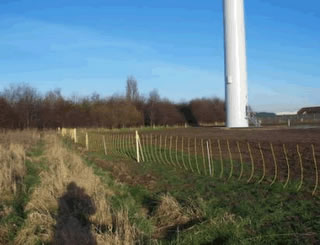
considered successful even if no dead or injured birds were found below the turbines as fox spoor was prevalent. The assumption was that these foxes were picking up any birds struck by the blades. An Electric fence was subsequently erected using a Hotshock energiser and Livestok Sheep nets.
"No evidence of fox prints at all were found whilst the fence was up and operational, the ground was soft for the majority of the study (sometimes frozen however), and so I would assume that tracks would have been easily visible. Before the erection of the fence, the site was covered in fox spoor and so the fence has appeared to certainly deter if not eliminate the foxes entirely from the area within the fence." Anna Phelps.B.Sc (hons), M.Sc. Researcher
Study by Vattenfall and Spoor shows not a single collision
The energy company Vattenfall and the tech company Spoor have analysed the extent to which wind turbines endanger birds at the offshore wind farm in Aberdeen. Over a period of 19 months - from June 2023 to December 2024 - video recordings of a wind turbine were made with the help of AI-supported analyses. A total of 2,007 bird flight paths near the monitored turbine were examined.
"By combining AI-powered detection and detailed expert analysis, we can replace assumptions with concrete observations and measure actual behaviour in the immediate vicinity of wind turbines," says Ask Helseth, Chief Executive Officer and co-founder of Spoor.
The study found that there was not a single collision, "The results from Aberdeen Bay show that modern offshore wind farms can be operated with low risk to wildlife," says Dr Eva Julius-Philipp, Director Environment and Sustainability BU Wind at Vattenfall.
German Offshore Wind Energy Association (BWO) study: Over 99 per cent of migratory birds avoid wind turbines
A study by the German Offshore Wind Energy Association (BWO) also shows that migratory birds almost completely avoid wind turbines.
For one and a half years, researchers analysed over four million bird movements with the help of radar and AI-based cameras. The result showed that over 99.8 per cent of migratory birds reliably avoided the wind turbines.
"The new study shows that migratory birds avoid wind turbines. This confirms that the environmentally friendly expansion of offshore wind energy works in harmony with these birds and not against them," says BWO Managing Director Stefan Thimm.
"We used state-of-the-art methods. AI-controlled stereo cameras determined the flight activity in the rotor area, while a specialised bird radar recorded the migration patterns. By comparing the two data sets, we were able to precisely calculate avoidance rates," says Dr Jorg Welcker, Head of Research and Development at BioConsult SH GmbH & Co.
These new studies suggest that many bird species collide with wind turbines less frequently than often feared. Just as they learn to fly away from an approach car they avoid the wind turbines.

← Older Post Newer Post →
0 comments