You have no items in your shopping cart.

Electric Chicken Netting Trial
Using Electric Chicken Netting to protect chickens from predatory Foxes
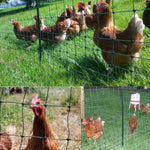
In order to test the effectiveness of Electric Chicken Netting in preventing Foxes from attacking poultry in an enclosure, 25 culled hens were purchased and a farm in a rural location was used for a trial utilising various forms of electric netting.
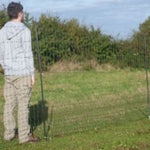
The birds were split into 5 lots and housed adjacent to each other in five 150 m2 runs (one 50m net) with a housing arc in each. The arc was left open permanently so the birds could move at will. The pens were sited in line 5m away from the hedgerow and 3m between runs.
Run One.
Control using plain chicken wire 1m tall, no electric fencing, no roof and not dug in.
Run Two.
5 line standard fencing 1m tall and energised, no netting. Bait was used.
Run Three.
Standard Flexinett Poultry netting 105cm tall with with Weed Suppression below the bottom line. Bait was used.
Run Four.
Livestok Sheep netting 105cm tall with Weed Suppression below the bottom line. Bait was used.
Run Five.
The Ultimate Chicken netting 145cm tall with Weed Suppression below the bottom line. Bait was used.
Runs two to five were linked to a 12v hotShock A90 energiser that registered 8000v when running on all the fences and nets. The bait stations were treated with a proprietary gravy mix twice weekly for three weeks and then left untreated on the fence thereafter. The ground between the runs was cleared by a harrow so that incoming spoor and reactions could be assessed. The chickens and trials were inspected on a daily basis. The birds were fed and watered daily. The trial ran during May/July when a vixen would be actively feeding cubs.
Trial Progress.
The first fox inspection occurred on night 3 when he tested a bait station on the Flexinett. His tracks indicated he got a shock and departed.
On night 5 a fox visited and walked around without attempting entry.
On night 6, all hens in the control were killed. There were signs that the fence was climbed over to gain entry. As expected, this attack showed that a simple fence was not effective as a barrier. These hens were not replaced as we had achieved our object in proving that foxes were active and intent on infiltrating the fences.
On night 7, the Livestok Net and Standard Flexinett Chicken net were tested in turn by the same fox. He was shocked by both and departed. No attempt was made to jump or climb over the nets despite being low enough for a fox to do so.
Visits from foxes were noted on several nights over the next 11 weeks but neither the nets nor fence was penetrated. Only twice were any of the fences tested again with the fox simply walking around the area. At no stage did the foxes try to jump over, nor to dig under despite being quite capable of doing so.
At no stage was the taller Ultimate Net tested by a fox - the height possibly an added deterrent.
On night 31 a hen was found to have been killed outside the runs and the 5 line Stock Fencing type was one short. There was no sign that the fox had infiltrated the run and it is assumed the hen had escaped and been killed outside the run.
The test was closed down 12 weeks (84 days) after the inception.
Conclusion
This un-replicated and observation test suggests that Electric fencing is very effective in combating the threat of Foxes to free-range poultry. That foxes did not jump over or dig under simply reinforces what is already known about animal behaviour regarding the electric field. They are unable to perceive its limits and extent, so do not try to go under or over the known field.
Complimentary Trial Results
This trial has been backed up by a trials done on other sites to exclude Foxes from Lesser Terns and other situations.
Study on Fox predation on Tern Colony, Sands of Forvie National Nature Reserve, Aberdeenshire, Scotland
"Tracks and scats of the foxes were first noticed near the colony on 28th. May, and almost daily thereafter. On 18, 19, and 20th. June, observers recorded that the incubating terns seemed "skittish, nervous and uneasy." This phenomenon was first thought to be associated with hatching but no chicks were noted. Nest numbers decreased from 138 to 129 on 20th. June, to 61 on 22nd. June. By 23rd. June only 45 tern nests remained. Fox tracks crisscrossed the colony.
On 24th. June the electric fence was erected. On 25th. June we noted a slight increase to 48 nests; a week later, 2nd. July, we counted 60 nests, and by 6th. July, 85 nests. Fresh fox tracks were seen near the colony but no tracks were found in the trial area. New nests outside the fence were consistently taken by the Foxes - none survived."
Cape Cod National Seashore in Massachusetts (USA)
A similar study, this time at a Least tern (Sterna albifrons) colony on the Cape Cod National Seashore in Massachusetts (USA) during the summer of 1978, found that, while new nests established outside of the fence were depredated by foxes, none of the foxes approached closer than three metres (10ft) to the fences, resulting in a substantial increase in the number of nests within the fenced area. In this case, even when the fence was turned off for a week, it still deterred the foxes. In his summary of the data, published in the Journal of Mammalogy during 1980, Dennis Minsky concluded that:
"there would have been virtually no production without the fence."
Hull University (UK)
Hull University have completed a study on the new 125m (410ft) wind turbine at the Croda Europe plant in Hull assessing the effect they have on the wild life. The fear is that birds are flying into the spinning blades. Initial assessments were not
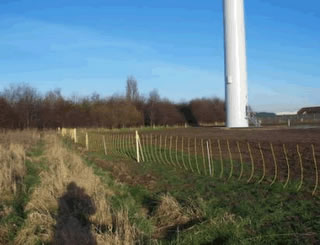
considered successful even if no dead or injured birds were found below the turbines as fox spoor was prevalent. The assumption was that these foxes were picking up any birds struck by the blades. An Electric fence was subsequently erected using a Hotshock energiser and Livestok Sheep nets.
"No evidence of fox prints at all were found whilst the fence was up and operational, the ground was soft for the majority of the study (sometimes frozen however), and so I would assume that tracks would have been easily visible. Before the erection of the fence, the site was covered in fox spoor and so the fence has appeared to certainly deter if not eliminate the foxes entirely from the area within the fence." Anna Phelps.B.Sc (hons), M.Sc. Researcher
Central Science Laboratory (CSL) 2002 (UK)
In a brief paper to the journal Mammal Review during 2002, Central Science Laboratory (CSL) biologists David Poole and Ian McKillop reviewed the effectiveness of electric netting and electric strained-wire at excluding foxes. The researchers set up the two types of fences in the enclosures of captive foxes and monitored how readily the animals crossed the barrier. Drs Poole and McKillop found that only one of their foxes refused to cross the unelectrified fence and netting (foxes can sometimes be fearful of novel items in their territory, this is called neophobia), with six out of the seven animals crossing it multiple times. In the case of the netting, foxes pushed underneath it, pulled it down or chewed a hole in it; in the strained-wire trials, the animals either pushed underneath the fence, or jumped through the upper wires where the gap was wider. None of the foxes crossed the electrified netting or fences, except during the daily maintenance checks, when the fright associated with an attendant in their enclosure was sufficient to cause them to ignore the risk and jump over. Curiously, even though the fence was easily low enough for the fox to jump, they were only seen to do so when an attendant entered the enclosure - this suggests that, if the motivation is sufficient, most barriers can be overcome.
The behavioural observations from the CSL experiments showed that, even though the fences prevented the foxes from crossing in most cases, the animals investigated them regularly and even after receiving a shock only stayed away for about an hour. The foxes investigated the fences with their nose (a highly innervated and sensitive part of their body) and most foxes were only shocked once; one was shocked twice, but none took more than two shocks to get the message. (Sections from Wildlife Online)
Featured